Fruit Machine Slots in the UK: How Online Reels Work
 Available in GB
A practical look at the shift from cabinets to screens, including RNG results, classic features, demos, bonus terms and RTP.
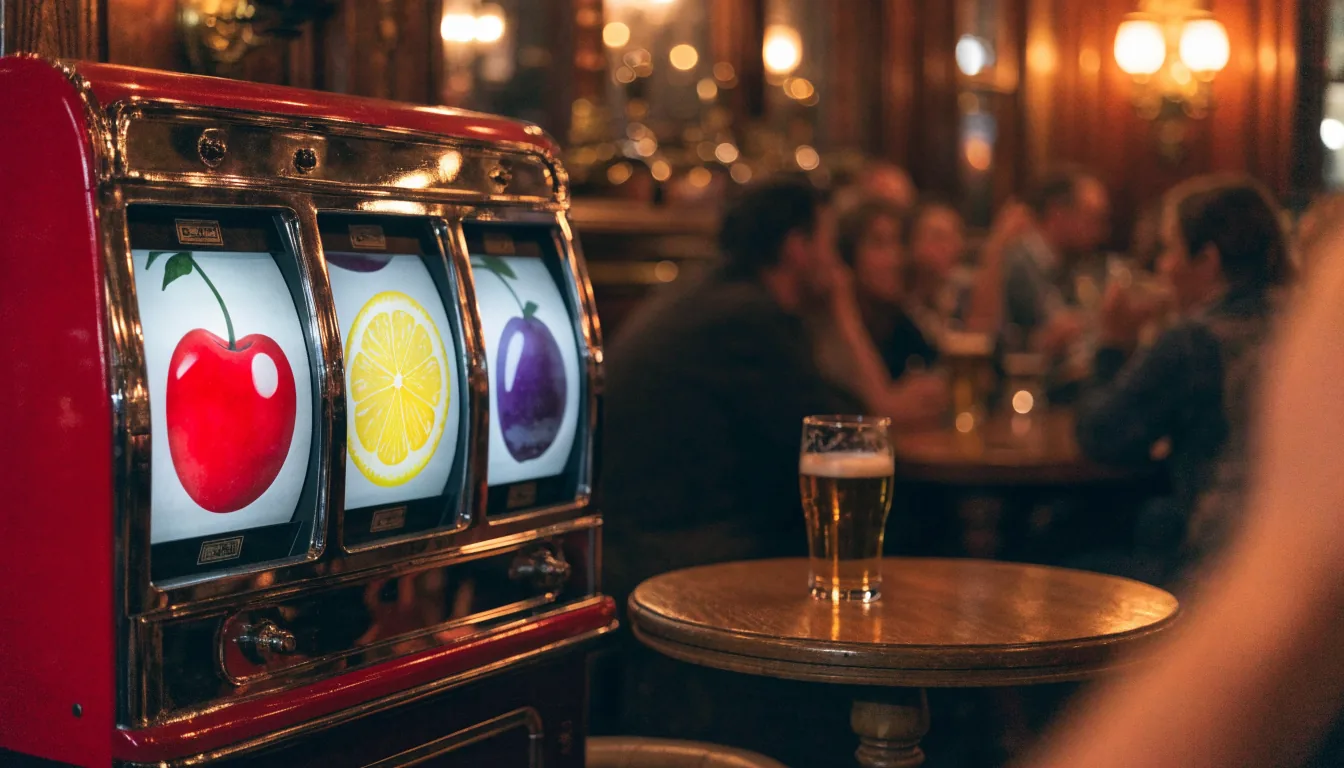
Table of Contents
- From Pub Fruit Machines to Online Reels
- What a UK-Licensed Fruit-Slot Casino Means
- Real-Money Play: Age Checks and Spin Caps
- Rainbow Riches and the Move from Cabinets to Screens
- The Reels Behind Fruit-Machine Casino Games
- Online Versions Add More Than a Screen
- Classic Fruit Slots: Holds, Nudges and Simpler Reels
- Fruit-Slot Demos: What This Guide Can Verify
- Fruit-Slot Bonuses and the Terms Behind Them
- RTP Is a Return Figure, Not a Payout Promise
From Pub Fruit Machines to Online Reels
The online fruit machine is a digital descendant of a familiar physical form. The setting has changed, but the basic appeal remains recognisable: symbols appear on reels, and a spin produces an outcome. That continuity is why the games are still called fruit machines, even when the reels are displayed on a phone or computer rather than inside a cabinet.
The important difference is not simply that one version has a screen. A physical machine and an online game may share a visual language, but the digital version uses software to determine each result. Online fruit-machine-style games use a random number generator, or RNG. It produces independent outcomes, so the result of one spin does not set up or predict the next.
That point can be easy to miss because the game presents a sequence of motion. Reels turn, symbols pass across the screen, and the display settles on a result. The animation gives the outcome a visible form; it does not mean the game is physically waiting for a symbol to land in the way a player might imagine from watching a cabinet. The RNG is the mechanism behind the result. The reel display is how that result is shown.
I have found that this distinction matters most when the presentation encourages a story about momentum. A run of symbols can feel as if it is building towards something, while a long stretch without a particular result can feel as if that result is due. Neither impression changes the independence of the next outcome. The screen gives each spin a beginning and an end, but it does not make previous spins a forecast.
Slots & Providers: UK Casino Categories
There is a useful way to think about the move from pub fruit machines to online reels: the theme travelled, while the means of producing results changed. The familiar symbols and reel-based display offer a bridge between the two formats. Under that surface, the digital game relies on its own random process rather than a physical mechanism. It is a change in how the game operates, not merely a change in where it is played.
That distinction also helps separate familiarity from equivalence. An online game may look like a fruit machine and carry the same general style, but appearance alone cannot establish that its mechanics match those of a particular physical machine. Nor does a familiar name or symbol tell the whole story about how a digital title works. The game’s own information is the place to understand its specific rules. The shared visual vocabulary is only the starting point.
For UK players looking at online fruit slots, this is the common foundation across the category. The cabinet is no longer present, and the spin is generated digitally. Each outcome is independent. Those statements explain the central shift without suggesting that every online title is identical: a fruit-machine theme can be carried into different games, with their own rules and presentation.
I used to think of the screen as a faithful window onto a machine. That is too simple. A digital game is not a cabinet viewed from a different angle; it is software using a recognisable fruit-machine format. Once that is clear, it becomes easier to read the animation for what it is: presentation, not evidence that a result is being physically coaxed into place.
Penny Slot Machines in the UK: Costs and Play
It also keeps expectations in proportion. A visual sequence can make a spin feel close, dramatic or unusually significant. Those impressions belong to the experience of watching the game. They do not override the RNG’s independent process. No symbol pattern on the previous spin can make the next one more certain, and a result that has just appeared does not, by itself, explain what comes next.
The phrase “old favourite” can therefore describe the look, not a promise of identical behaviour. Online fruit machine slots UK players encounter belong to a digital format with random outcomes, even where the reels recall the pub machine that inspired the style. The lineage is real; so is the change in mechanism. That is the useful dividing line.
Recommended online casinos
- BritsinoBonus: Welcome Package – Get your £2,200 + 2,000 FS · Payout speed: 1-3 business days
- NightLuckBonus: Welcome Pack + 805% Up To 6400€ + 280 FS · Payout speed: 1-3 business days
- x3betBonus: Welcome Pack 100% Up to £1.000 + 200 Free Spins · Payout speed: 1-3 business days
- SpinFormulaBonus: 550% Up To £15,000 + 550 FS · Payout speed: 1-3 business days
- JetsetspinsBonus: 200% Bonus + 100 Free Spins + Free Royal Wheel · Payout speed: 1-3 business days
- BeOnBetBonus: 100% up to €500 + 100 FS · Payout speed: 1-3 business days
What a UK-Licensed Fruit-Slot Casino Means
A fruit machine’s familiar symbols do not determine whether the casino offering it is authorised to serve people in the UK. Licensing applies to the operator and its gambling activity, not to the theme on the reels. A site can feature cherries, bells and other pub-fruity imagery, but those pictures do not make it a UK-licensed casino.
The relevant regulator is the UK Gambling Commission. An online casino targeting UK players must hold a valid Gambling Commission licence. That requirement applies whether the operator is based in Britain or elsewhere: serving the British market is what brings the operator within the licensing requirement. In practical terms, a fruit-slot casino is not UK-licensed because it uses a British-sounding name, carries familiar games or displays a licence claim without substance. Its operating status matters.
UK Gambling Casino Sites: Slots, Licensing and Costs
I have seen how easily the two ideas get blurred in casino marketing. A game may be described as “British”, “classic” or “authentic”, which says something about its look or style, not about the legal status of the site hosting it. Equally, a casino’s UK licensing status does not mean every game there has a fruit-machine theme. Regulation and game design sit on separate tracks.
The operator’s licence and the game’s theme
Fruit slots are a category of casino game. Their symbols and presentation may recall physical fruit machines, but a visual resemblance is not a regulatory credential. A title’s provider, cabinet history or familiar artwork cannot substitute for the operator’s Gambling Commission licence.
That distinction matters when people look for an online casino with fruit slots in the UK. The sensible order is to establish whether the operator is authorised for the market, then consider whether its game catalogue includes the style of fruit machine wanted. Reversing that order gives the theme too much weight. A well-known title can make a site feel familiar; familiarity alone does not establish that the operator is licensed.
Nor does a licence turn a particular game into a better game. It does not tell a player whether the fruit symbols are appealing, whether the layout resembles a pub machine, or whether a particular title is available at that casino. Those are separate questions. The licence is about the operator’s permission to provide gambling services into the regulated market.
When I assess the wording around a casino, I treat claims about the games and claims about regulation as different things. “Fruit slots available” is a catalogue statement. “Licensed for the UK market” is a regulatory statement that should correspond to the operator’s actual status. One cannot be inferred from the other.
Why location can mislead
A company’s registered or operating location is not the deciding point for UK-facing online casino services. An operator abroad still needs the relevant UK Gambling Commission licence if it targets UK players. Conversely, a site does not become licensed merely because it is accessible from Britain or accepts British customers.
Unlicensed Sites
Unlicensed offshore sites do not provide UK regulatory protections, and players may face risks such as manipulated games or withheld winnings with limited legal recourse.
This is where a polished presentation can obscure the important distinction. A site may use familiar language, promote recognisable fruit-machine games or make a licence sound incidental. None of that changes the market-access rule. Online gambling in the UK is legal through licensed and regulated sites; an operator serving the market must hold the appropriate current authorisation.
Unlicensed offshore sites sit outside the UKGC system. They do not provide the same UK regulatory protections, and players may face risks such as games being manipulated or winnings being withheld, with limited legal recourse. The fact that an offshore site is reachable does not make it a lawful UK casino. I regard that as a basic boundary, not a fine-print detail.
What the licence does—and does not—say
A UKGC licence establishes that the operator is authorised to offer the relevant gambling services in the UK market. It should not be read as a promise that every game will suit every player, that a fruit-slot title will always be present, or that a particular outcome is assured. Those are not what an operating licence means.
The same restraint applies to labels such as “best”. A casino may be called the best fruit-slots destination in promotional copy, but that wording is not a licensing category. A search for a UK casino with fruit slots therefore involves two distinct checks: whether the operator holds the required licence, and whether its current selection contains the games of interest. Neither check answers the other.
Top rated online casinos in the UK: ratings explained
This separation is useful because casino language often places trust signals beside entertainment claims. A familiar game can be a genuine reason to browse a catalogue, while the regulator’s role concerns the operator’s authority to serve the market. The two can appear together on a page, but they do different jobs.
For fruit slots, then, “UK-licensed” describes the casino operator’s regulatory position, not the fruit-machine theme, the game’s mechanics or its resemblance to a cabinet. Keep those categories separate. That is the point.
Real-Money Play: Age Checks and Spin Caps
Real-money play on fruit-machine games in the UK is conditional, not simply a matter of opening a game and pressing spin. A player must be at least 18 and register with an identity that has been verified. That requirement applies to online fruit slots whether the game resembles a pub fruity or uses a newer digital format. The theme does not create an exception to the rules for playing with money.
Age and identity checks form part of the operator’s process for establishing who is using an account. Registration is therefore more than a username and password: real-money access depends on the identity being verified. I see that distinction as important. A game can be visible on a casino site without every visitor being eligible to play it for money. Browsing the lobby and staking cash are different steps.
For players who meet the age and identity requirements, the amount that can be staked on an online slot is also capped. In Great Britain, the maximum stake is £5 per spin for players aged 25 and over. For players aged 18 to 24, it is £2 per spin. The lower cap applies to that younger adult age group; reaching 18 makes someone eligible to gamble, but it does not put them in the higher stake category.
Stake Limits
In Great Britain, the maximum stake per spin is £5 for players aged 25 and over, and £2 for those aged 18 to 24.
The £5 limit for adults aged 25 and over took effect on 9 April 2025. These are limits for online slots, not separate allowances created by a fruit-machine theme. A game styled as a classic fruit machine remains an online slot for this purpose. The relevant distinction is the player’s age group and the stake on a spin, not whether the reels show fruit symbols or whether the game imitates a physical cabinet.
This can be easy to miss when a casino presents many games in one lobby. The stake setting is part of the real-money transaction, rather than a decorative preference. A lower displayed stake may be available, but the legal maximum is not a target or a recommended amount. Nor does a higher age threshold let a player move above the applicable cap. The rules set a ceiling; they do not say what amount is suitable for an individual.
Enforcement sits with the operator. The applicable per-spin limit must be applied at account level, and the operator cannot let a player exceed it. In practical terms, the cap is not meant to depend on a player noticing a warning or remembering to reduce a stake. The control has to prevent an over-limit stake from being accepted. That is a different arrangement from a voluntary spending setting, which a customer might choose for personal budgeting.
Amatic Online Casinos UK: Games and Casino Rules
The same account-level principle matters when a player visits different games within a casino. A themed lobby does not create a way around the cap, and changing titles does not turn the limit into a game-by-game extra. The rules concern online slot stakes. They are not an offer attached to a particular fruit title and cannot be treated as optional game settings.
I separate three questions when looking at real-money access: whether the player is old enough, whether their identity has been verified, and whether the intended stake falls within the limit for their age group. They are related conditions, but one does not replace another. Being over 18 does not remove the identity requirement; being verified does not alter the age-based cap; and the cap does not make someone eligible if they have not met the age and registration conditions.
The monetary boundary can also be mistaken for a spending recommendation. It is not. A permitted stake is only the maximum that may be placed on a spin, not evidence that repeated play is affordable or likely to produce a return. I treat fruit slots as entertainment, not as a way to make money. A budget should be set before play, with losses kept within money that can be afforded to lose. A clipped rule is still a hard rule.
These conditions apply to real-money fruit-machine slots in Great Britain, where the online slot stake caps distinguish between the two adult age groups. For anyone under 18, real-money play is not permitted. For adults, verified identity and the relevant stake ceiling remain separate gates. The commercial language around a game may make access look immediate; the controls behind the account are more exact than the presentation.
Do
- Verify your identity during registration
- Check that your stake falls within the age-based limit
- Set a budget before playing
Don’t
- Attempt real-money play if under 18
- Assume verification removes the stake cap
- Treat fruit slots as a way to make money
Rainbow Riches and the Move from Cabinets to Screens
Rainbow Riches began as a physical fruit machine, not as an online game designed to resemble one. Barcrest introduced it on cabinets in UK pubs, arcades and betting shops in 2006. Around 2009, the title moved online. That short timeline captures a wider change in how a familiar pub fruity could travel: the name and recognisable identity crossed from a cabinet into a digital format, while the way the game was delivered changed with it.
I find that distinction useful when looking at fruit machine slot games. A move online can make a title feel continuous, but it does not mean that the cabinet and online versions are identical in every operational detail. They are separate versions of a game, offered through different settings. The physical machine was encountered at a venue; the online version became available through a screen. Familiarity with the title can bridge that gap, but it should not blur it.
Rainbow Riches is a clear example because its history starts in places where traditional fruit machine games were part of the surroundings: pubs, arcades and betting shops. The cabinet format made the game a piece of venue equipment. Its online arrival shifted the point of access from a machine on a premises to a digital product. The title’s journey was not simply a matter of putting a picture of a cabinet on a website. It was a change in how the game reached its audience.
That matters when comparing online fruit slot games with older cabinet versions. The same name can invite an assumption that the experience, including its return setting, must be the same. The published figures for Rainbow Riches show otherwise: the online version has a stated RTP of 95%, while physical machines are generally set to return less. No cabinet percentage follows from that comparison, and it would be misleading to invent one. The useful point is the direction of the difference, not a made-up figure for the physical game.
Novomatic Online Casinos UK: Amatic Game Availability
RTP is a long-run return measure, not a promise about what happens during an individual play session. In this case, it helps explain why a familiar title can have different published figures across formats. A physical machine and an online game may share a name, yet the figure associated with one should not automatically be carried over to the other. I treat the version itself as part of the information, not as a minor detail hidden behind the title.
This is also why “classic” can be an imprecise label. It may refer to the memory of a cabinet, the continued use of the game’s name, or the style of a digital version. Those associations are not proof that every version runs under identical settings. Rainbow Riches offers a concrete case: its route from Barcrest cabinets to online play is well established, but the online return figure should be read as belonging to the online version.
For people looking at fruit themed slot games, the history adds context without turning the title into a ranking. Rainbow Riches is notable here because it connects two eras of play in the UK market: the cabinet in a venue and the online game on a screen. That makes it a useful example of continuity in branding alongside a change in format. It does not, by itself, establish that it is the best fruit slot, or that every casino offers the same build.
The phrase “same game” can do too much work. In everyday conversation, it may mean the title is familiar; in a comparison, it can be mistaken for a claim that every version has matching settings. The distinction is practical. Someone comparing fruit machine slot games should identify the version being discussed and use the information displayed for that version, rather than relying on an old memory of a cabinet or a figure attached to another format.
Pragmatic Play Online Casinos in the UK: What to Check
Rainbow Riches did not begin online and later acquire a cabinet-style appearance. It travelled in the opposite direction: from Barcrest machines in UK venues to online play around three years later. Its history explains why a digital fruit machine can feel rooted in a physical tradition, while its different RTP figures show why format still matters. Familiar name. Separate version.
The Reels Behind Fruit-Machine Casino Games
A modern fruit-machine game often keeps the familiar shape of a cabinet display: five reels, with three visible rows on each. The symbols land in a grid, but the layout alone does not explain how a win is assessed. The important distinction is whether the game uses fixed paylines or a ways-to-win system.
With fixed paylines, the game has set routes across the reels. A line may run straight across or follow a pattern through the grid; the game’s paytable shows which routes count and what symbol combinations they recognise. The number of lines is fixed rather than chosen spin by spin. Across modern fruit-machine games, the stated range is 10 to 50 paylines.
That structure is easy to read once the paytable is open. It also makes the line count a poor shortcut for judging a game. More lines do not, by themselves, tell anyone how often a win will land or how much it will pay. I look at the rules for the actual title, not the visual density of the screen. Layout is not value.
Some games use 243 ways to win instead. Here, wins are evaluated through symbol combinations across the reels rather than through a list of numbered paylines. The phrase can sound like a promise of more frequent returns; it is a description of the game’s counting system, not a forecast of results. Each spin still produces its own outcome.
For a fruit slot casino game, these formats are worth distinguishing before play because they change how a winning combination is identified. On a fixed-line game, the paytable’s line patterns matter. With 243 ways to win, the relevant rules explain which reel combinations qualify. A familiar fruit theme does not mean two games share the same layout or evaluation method.
Fixed Paylines
Wins are based on set routes across the reels, typically ranging from 10 to 50 lines.
243 Ways to Win
Wins are evaluated through symbol combinations across the reels rather than fixed numbered lines.
The practical check is modest: open the game information and see whether it specifies fixed paylines or 243 ways to win, then read the matching symbol rules. That tells more than the artwork does. Different framework, same uncertainty.
Online Versions Add More Than a Screen
A specialist review describes online fruit-machine games as potentially offering features beyond the reel display: free spins, pick-style mini-games, autoplay, quick spin and mobile compatibility. That is a menu of possibilities, not a standard package. A particular title may have some of these functions and omit others, so the feature panel or game information is more useful than a broad label such as “modern”.
The names indicate different kinds of interaction. Free spins add a defined feature round; a pick-style mini-game asks for selections within a separate game sequence. Autoplay handles repeated spins automatically, while quick spin changes the pace of the on-screen action. Those options affect how play is presented, rather than describing the shape of the reels. The distinction matters: a game can retain a familiar fruit-machine appearance while adding interface choices that would not have been available on a physical cabinet.
I have found that feature lists can make a title sound more distinctive than it is. A button is not a benefit by itself. Autoplay, for instance, is a control over repeated play, not a change to the game’s underlying character. Quick spin is about presentation speed, not a different kind of fruit machine. Pick rounds add a decision point, but their presence alone says nothing about the result. Small distinction. Important one.
Stakelogic Online Casinos UK: What Can Be Verified
Mobile compatibility is another practical layer. It means the game is designed to work on mobile devices, but that label does not establish how every title will appear or behave on every screen. The game’s own interface is the relevant detail; a general description cannot guarantee identical presentation across devices.
These features also should not be confused with the cabinet-style layout of a game or with the terms attached to a promotion. Free spins can appear as a game feature, but an offer involving them has its own conditions. The game’s feature description explains what is available within play; promotion terms explain the conditions of an incentive. They answer different questions.
For online fruit-machine play in the UK, the useful comparison is therefore not simply how many extras are listed. It is which features the specific title actually presents and whether those controls suit the intended style of play. A long menu can still be mostly interface.
Classic Fruit Slots: Holds, Nudges and Simpler Reels
Classic fruit-machine games keep the layout spare: three reels, one payline and few added features. That gives the symbols and the line itself most of the attention. There is less to interpret on screen than in a more elaborate game, but a simple layout does not make an outcome predictable.
How holds and nudges work
A hold leaves a selected reel in place while others spin again. A nudge shifts a reel down by one position after a spin to change the symbol on the payline.
The familiar controls are holds and nudges. A hold leaves a selected reel in place while the other reels spin again. A nudge shifts a reel down by one position after a spin, changing which symbol sits on the payline. Both features give a spin another point of interaction, but neither guarantees a match. The symbols still have to line up for a winning combination.
I have seen these features described as if they were standard equipment on every classic fruit slot. They are not. A specialist review notes that their availability and number vary by title, and that a game may make them conditional. Some titles may offer more than one hold or nudge; others may provide them only in particular circumstances. The game’s own information is the place to confirm what its controls do and when they can be used.
That distinction matters. A button labelled “hold” can sound like a way to preserve a near-win, while “nudge” can suggest that a player can steer the result. In practice, these are features within the game’s rules, not a route to choosing the symbols. Holds keep reels still for a subsequent round; nudges move a reel by one position. The underlying random process that determines outcomes is not changed by either feature.
The appeal is partly mechanical. A single line is easy to follow, and a hold or nudge offers a small decision without adding a complicated layout. But the decision is about using an available feature, not controlling what the next outcome will be. The distinction is plain. Interaction, not control.
Amatic Games at UK Casinos: How to Check
Fruit-Slot Demos: What This Guide Can Verify
A fruit-slot demo sounds straightforward: try a game without making a real-money spin. But the label alone does not establish which UK casinos make a particular title available to play this way, or what that session allows. I would not treat a demo button, a game listing or promotional wording as proof of its conditions.
Online fruit-machine-style games use random number generators, with each outcome independent of the previous one. That explains how the game’s results are produced; it does not establish that a demo uses the same configuration as a casino’s real-money version, or that results in one mode predict results in another. A run of symbols on screen is not evidence of what a later spin will do.
The practical details also matter. A demo may be described in broad terms, while its rules could determine whether play is available without registration, whether a balance is involved, or whether a feature can be accessed. Those permissions should not be inferred from the word “demo”. The game’s own information and the casino’s live terms are where any stated conditions need to be checked.
I have seen promotional language make a mode sound more revealing than it is. “Try before you play” can suggest a test run, but it does not by itself explain the game version, the permitted features or how outcomes relate to real-money play. A demo is not a forecast.
Demo Mode
Attention: A demo session is not a forecast; it does not establish that the demo uses the same configuration as the real-money version or predict future results.
For fruit slots in the UK, the reliable distinction is between what can be explained about online game mechanics and what must be confirmed for a specific title and casino. Without explicit terms for that particular demo, its availability and permissions remain unconfirmed. No shortcut.
Fruit-Slot Bonuses and the Terms Behind Them
A bonus headline describes the amount offered; the wagering requirement determines how much qualifying play must take place before bonus-related funds can be withdrawn. That distinction matters more than the headline. A large offer can carry a substantial play-through obligation, while the rules governing that obligation set a ceiling for UK promotions.
The UK Gambling Commission’s social responsibility rules cap wagering requirements on bonus funds at ten times the bonus amount. The limit is set out in Social Responsibility Code 5.1.1. In practice, that means the requirement cannot be used to turn a bonus into an open-ended commitment to keep betting. The stated multiplier still needs to be read alongside the promotion’s other terms: eligibility, qualifying games and the contribution each game makes to wagering can affect how the requirement works.
I have seen promotional language make the offer sound like the main event. It is the conditions that determine its practical value. A fruit slot being available in a casino does not, by itself, mean that it qualifies for a particular promotion or counts fully towards its wagering requirement. Those details belong in the live terms, not in the game’s name or artwork.
The relevant UK wagering and mixed-product incentive rules became effective on 19 January 2026. The mixed-product restriction means a single incentive cannot combine gambling product types such as betting and casino play. That matters when an offer is presented across a site with several kinds of gambling: the promotion must be structured within the rules, rather than treating all activity as interchangeable.
“Bonus” is the inviting word. The requirement is the contract behind it. I would assess the full terms before treating an offer as useful, and keep the promotional balance separate from money available to withdraw. The headline is only the entry point.
RTP Is a Return Figure, Not a Payout Promise
RTP, or return to player, is a published percentage describing the share of stakes a game is designed to return over extended play. For UK fruit-machine-style slots, the typical stated range is 94% to 97%, although individual titles can sit outside it. The figure is useful for comparing game information, but it does not forecast what happens in a particular session or guarantee that a stake will come back.
That distinction matters when a game is labelled “high payout”. The phrase can make a title sound more generous in every round, when RTP is a theoretical measure rather than a promise about individual results. A short run of spins may look very different from the published figure. In my experience, the label is less useful than the detail behind it.
There is another complication: the same title may be available in versions with different published RTPs. A specialist review notes that figures can vary between versions, so a number seen in a general game description may not match the build offered by a particular casino. The casino’s own paytable is the relevant place to confirm the RTP for that version. Check the game information before play.
This is why a list of “high-payout” fruit slots can mislead if it treats a title’s name as enough to identify its return. The available figure belongs to a specific version, not necessarily every copy of the game. If no RTP is displayed clearly in the paytable or game help, there is no sound basis for assuming that another listing applies.
RTP is one comparison point, not a measure of certainty or a way to make gambling profitable. Set a budget before playing and treat any winnings as a bonus, not income. No promised return.
Can I play fruit slots for real money in the UK?
Yes. You must be at least 18 and register with verified identity, and the casino must hold a valid UK Gambling Commission licence.
How do holds and nudges work in online fruit machine slots?
A hold keeps selected reels fixed while the others spin again; a nudge moves a reel by one position after a spin. Their availability and conditions vary by game, and neither changes the random process behind outcomes.
What is the maximum wagering requirement in Great Britain?
For bonus funds, the maximum is 10 times the bonus amount.
Prepared by the Avantgarde Casino editorial staff.